AP Chemistry practice tests
AP Chemistry is one of the College Board's Advanced Placement exams: a May exam on a college-level course taken at school, whose 1-5 score universities use for credit or advanced placement.
AP Chemistry
- Tests
- 11
- Free
- 1
- Assessment areas
- 2
- Minutes
- 195
No card required for the free test.
What AP Chemistry involves
NewEducare's AP Chemistry tests follow the May 2027 digital AP format, 3 hours 15 minutes of working time, with a 10-minute break after Section I. Section I: 60 multiple-choice questions in 90 minutes, with the Desmos scientific and graphing calculators; Section II: 7 free-response questions in 105 minutes, with the Desmos scientific and graphing calculators. Free-response answers are written on paper and photographed, as on the real exam, or typed.
- Who takes it
- Secondary-school students taking the course, who send the score to universities for credit or advanced placement.
- How it is scored
- 1-5, with 5 the highest. College Board does not publish the composite score each grade needs, so the 1-5 score in a NewEducare report is an estimate.
NewEducare marks the multiple choice of each AP Chemistry test and estimates every free-response answer against scoring-guideline rows with AI, then reports an estimated AP score from 1 to 5, a composite and the multiple choice by unit.
Available AP Chemistry tests
11 full-length tests, each with 2 assessment areas and 195 minutes of working time. Every question carries a worked explanation you can read after submitting.
- Free Full Length AP Chemistry Practice TestAP Chemistry · 195 minFree
- Full Length AP Chemistry Practice Test 1AP Chemistry · 195 min$11.99
- Full Length AP Chemistry Practice Test 2AP Chemistry · 195 min$11.99
- Full Length AP Chemistry Practice Test 3AP Chemistry · 195 min$11.99
- Full Length AP Chemistry Practice Test 4AP Chemistry · 195 min$11.99
- Full Length AP Chemistry Practice Test 5AP Chemistry · 195 min$11.99
- Full Length AP Chemistry Practice Test 6AP Chemistry · 195 min$11.99
- Full Length AP Chemistry Practice Test 7AP Chemistry · 195 min$11.99
- Full Length AP Chemistry Practice Test 8AP Chemistry · 195 min$11.99
- Full Length AP Chemistry Practice Test 9AP Chemistry · 195 min$11.99
- Full Length AP Chemistry Practice Test 10AP Chemistry · 195 min$11.99
After your AP test: the AI Tutor
On the AP it works through Multiple Choice, Free Response and Short Answer questions.
FreeYour first 2 mistakes are free (up to 10 minutes)
Then 30-minute blocks at $3.99 · No card needed to try it, just your account.

AP Chemistry: the course outline behind the exam
“AP Chemistry is an introductory college-level chemistry course. Students cultivate their understanding of chemistry through inquiry-based investigations as they explore topics like atomic and molecular structure, chemical reactions, kinetics, equilibrium, and thermodynamics.” College Board
Nine units make up AP Chemistry in College Board's framework.
Unit 1Atomic Structure and Properties
7%–9%You'll learn about the composition of atoms and ways scientists measure and categorize these building blocks of matter.
Topics may include:
- Moles and molar mass
- Mass spectra of elements
- Elemental composition of pure substances
- Composition of mixtures
- Atomic structure and electron configuration
- Photoelectron spectroscopy
- Periodic trends
- Valence electrons and ionic compounds
Unit 2Compound Structure and Properties
7%–9%You'll discover the range of chemical bonds and how their structure can affect the properties of the molecules created.
Topics may include:
- Types of chemical bonds
- Intramolecular force and potential energy
- Structure of ionic solids
- Structure of metals and alloys
- Lewis diagrams
- Resonance and formal charge
- VSEPR and hybridization
Unit 3Properties of Substances and Mixtures
18%–22%You'll explore how atoms come together to create solids, liquids, and gases, and how forces between particles govern the properties of everything around you.
Topics may include:
- Intermolecular forces
- Solids, liquids, and gases
- Kinetic molecular theory
- Solutions and mixtures
- Properties of photons
- Spectroscopy
Unit 4Chemical Reactions
7%–9%You'll learn how to differentiate physical and chemical processes, and how to measure and express chemical reactions via chemical equations.
Topics may include:
- Introduction for reactions
- Net ionic equations
- Representations of reactions
- Physical and chemical changes
- Stoichiometry
- Types of chemical reactions
Unit 5Kinetics
7%–9%You'll explore various methods to observe the changes that occur during a chemical reaction, the factors that influence reaction rate, and how it relates to a series of elementary reactions.
Topics may include:
- Reaction rate
- Introduction to rate law
- Elementary reactions
- Collision model
- Introduction to reaction mechanisms
- Multistep reaction energy profile
- Catalysis
Unit 6Thermochemistry
7%–9%You'll learn about energy changes in chemical reactions and how a transfer of energy can change a substance's physical qualities.
Topics may include:
- Endothermic and exothermic processes
- Heat transfer and thermal equilibrium
- Heat capacity and calorimetry
- Energy of phase changes
- Introduction to enthalpy of reaction
- Enthalpy of formation
- Hess's law
Unit 7Equilibrium
7%–9%You'll chart how chemical reactions change over time, what causes substances to reach equilibrium, and how systems react when that equilibrium is disturbed.
Topics may include:
- Introduction to equilibrium
- Calculating the equilibrium constant
- Calculating equilibrium concentrations
- Introduction to Le Châtelier's principle
- Introduction to solubility equilibria
Unit 8Acids and Bases
11%–15%You'll learn more about pH, the qualities and properties of acids and bases, and how they interact in chemical reactions.
Topics may include:
- Introduction to acids and bases
- pH and pOH of strong acids and bases
- Acid-base reactions and buffers
- Molecular structure of acids and bases
- pH and pKa
- Properties of buffers
- pH and solubility
Unit 9Thermodynamics and Electrochemistry
7%–9%You'll be introduced to the concept of “thermodynamic favorability” for reactions, meaning how likely they are to occur given energy changes and environmental factors, and how chemical reactions can be used to generate electricity.
Topics may include:
- Introduction to entropy
- Gibbs free energy and thermodynamic favorability
- Thermodynamic and kinetic control
- Free energy and equilibrium
- Free energy of dissolution
- Galvanic (voltaic) and electrolytic cells
- Electrolysis and Faraday's laws
Shares are College Board's ranges for the multiple-choice section only.
Science Practices College Board assesses in AP Chemistry
- Models and Representations
- Describe models and representations, including across scales.
- Question and Method
- Determine scientific questions and methods.
- Representing Data and Phenomena
- Create representations or models of chemical phenomena.
- Model Analysis
- Analyze and interpret models and representations on a single scale or across multiple scales.
- Mathematical Routines
- Solve problems using mathematical relationships.
- Argumentation
- Develop an explanation or scientific argument.
How the AP Chemistry paper is built
This is a hybrid digital exam. Students complete multiple-choice questions and view free-response questions in the Bluebook testing app. They handwrite their free-response answers in paper exam booklets that are returned for scoring.
College Board’s date for AP Chemistry: Thursday 6 May 2027 (session 2).
Section I: Multiple Choice
60 Questions · 1 Hour 30 minutes · 50% of Exam Score
- Questions are either discrete questions or question sets, in which students are provided with a stimulus or a set of data and a series of related questions.
Section II: Free Response
7 Questions · 1 Hour 45 Minutes · 50% of Exam Score
- There are 3 long-answer and 4 short-answer questions. Long-answer questions are worth 10 points each; short-answer questions are worth 4 points each.
- The questions assess all 6 of the course skills: models and representations, question and method, representing data and phenomena, model analysis, mathematical routines, and argumentation.
What College Board tells AP Chemistry candidates
Section I: Multiple Choice
- The multiple-choice section includes individual, single questions as well as sets of questions that refer to the same diagram or data presentation.
- Questions will test your ability to:
- Explain, analyze, and interpret models and representations of chemical properties or phenomena
- Design experiments and procedures to test a prediction or theory
- Solve problems using mathematical relationships
- Make or justify a scientific claim and support it with evidence and/or reasoning
- A scientific or graphing calculator is recommended for use on Section I
Section II: Free Response
- The free-response section includes three long, multipart questions (worth 10 points each) and four short-answer, multipart questions (worth 4 points each).
- Questions will test your ability to:
- Explain, analyze, and interpret models and representations of chemical properties or phenomena
- Design experiments and procedures to test a prediction or theory
- Represent data and chemical phenomena with graphs and diagrams
- Solve problems using mathematical relationships
- Make or justify a scientific claim and support it with evidence and/or reasoning
- A scientific or graphing calculator is recommended for use on Section II.
AP Chemistry on a UCAS application
- Edinburgh's Biomedical Sciences degrees require both Chemistry and Biology, each met by an AP exam at grade 4 or 5.
- Its Medicine (MBChB) entry from high school asks for at least three AP scores at grade 5, with Chemistry required and two of Biology, Physics and Math/Calculus.
- King's College London turns an A-level subject grade into an AP grade (A* or A: a 5; B: a 4), and counts AP exams, not AP classes.
Sources: College Board's AP Central and AP Students pages (read 13 October 2026 and 18 November 2026); the UK universities' admissions pages (read 18 November 2026).
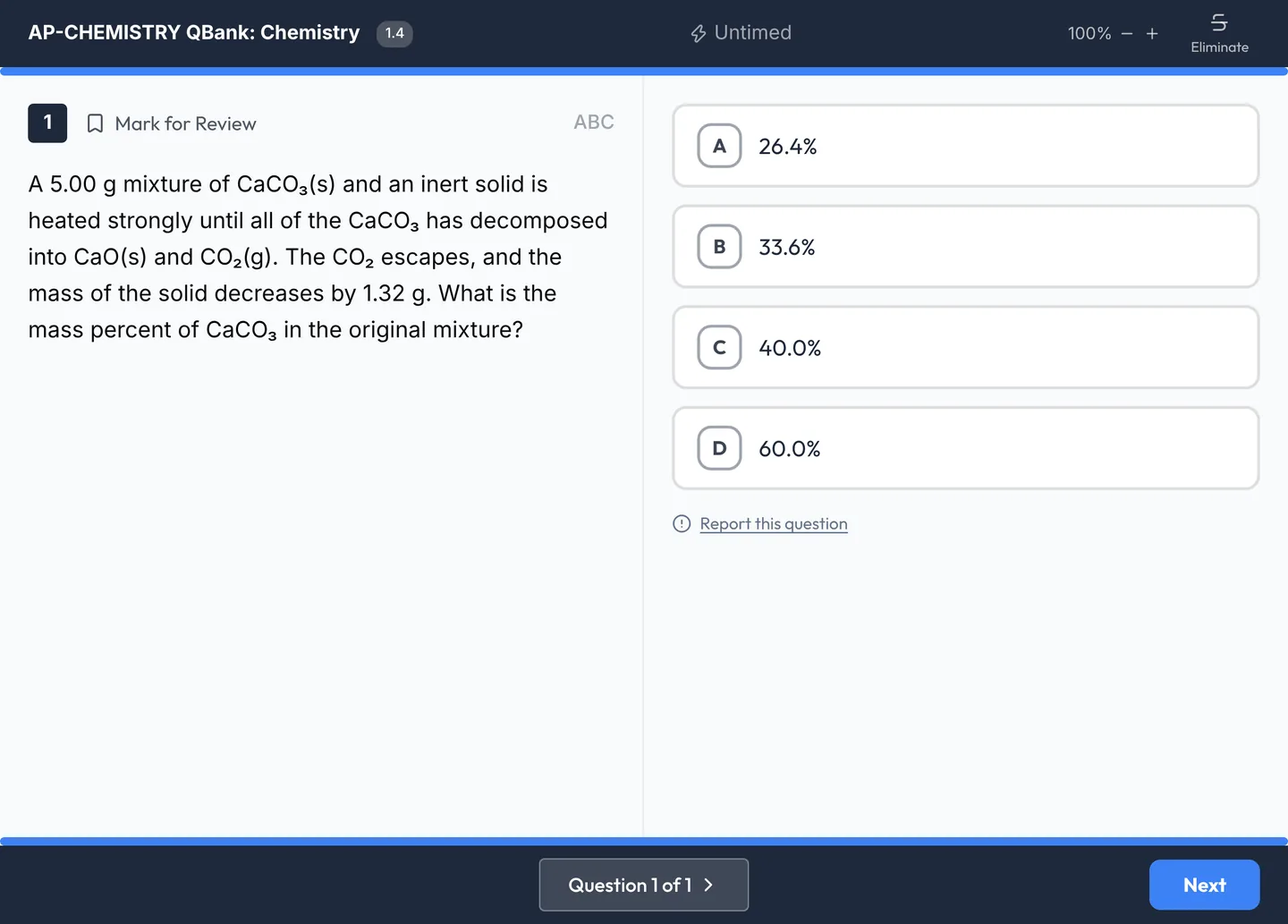
Know the screen before test day.
- AP Chemistry tools, on screen
- The Desmos scientific and graphing calculators in every part. Mark for Review and the option eliminator on every question, and the reference sheet open throughout.
- How the test runs
- The parts run in order, each on its own clock. A part cannot be reopened once it ends.
A full-length test needs a free account, and the test runs in full screen. Nothing is timed until you start.
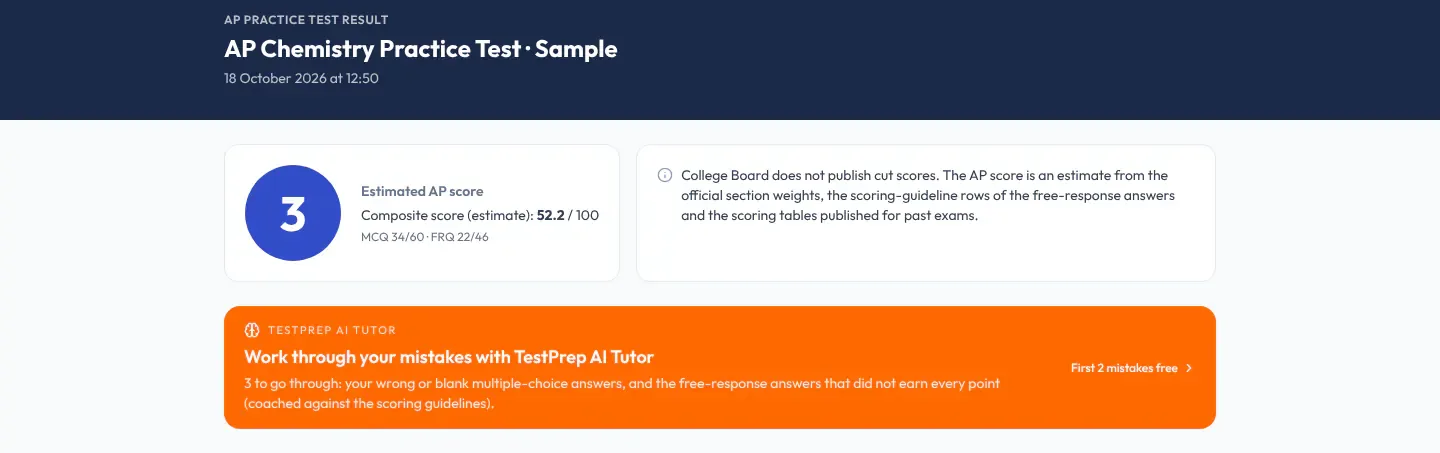
See what the score is made of.
- In the AP Chemistry report
- The multiple choice of each test is marked and every free-response answer is estimated against scoring-guideline rows with AI; the report gives an estimated AP score from 1 to 5, a composite and the multiple choice by unit.
Read each free response's AI estimate and feedback, then the multiple-choice questions in your weakest unit.
Counted your multiple choice and free-response points? Turn them into an AP Chemistry composite with the AP score calculator, which scores them the way this site’s AP practice-test report does.
AP Chemistry practice questions, answered
How many AP Chemistry practice tests does NewEducare have?
There are 11 full-length AP Chemistry practice tests, 1 of which is free. Each is a complete test with every section, not a sample of questions.
Are these real AP Chemistry questions?
No. Every question is written for NewEducare to match the published format, difficulty and topic distribution of AP Chemistry. Real exam questions are copyrighted and cannot lawfully be republished.
Is the AP Chemistry practice test timed like the real exam?
Yes. Each section runs to the official time limit, the timer continues if you leave the tab, and the test submits itself when time runs out — the same constraint you face on test day.
Can I retake an AP Chemistry practice test?
Yes, once: free or bought, each test allows one retake, and both attempts are kept for comparison.
Do I get explanations for the AP Chemistry questions I get wrong?
Yes, after you submit: your answer, the correct one and a worked explanation, for every question. None reaches the browser before submission.
Which AP Chemistry purchases include the advanced performance analysis?
A 10-test pack and the AP Chemistry course in the AP question bank each include the advanced performance analysis, in the Progress tab of your panel. It shows: accuracy by section, topic and subtopic; results on easy, medium and hard questions; time use in practice tests (rushed, on time, slow); your 6 weakest topics, each with a link to practise it in the question bank; weekly progress chart.
Written and reviewed by the NewEducare editorial team · Last updated
AP Chemistry is a trademark of the College Board. NewEducare is an independent practice-test provider and is not affiliated with, endorsed by, or accredited by the College Board. The name is used here only to identify the exam these practice tests prepare for.